| Rollsigns from New Jersey Public Service Predecessor to NJ Transit |
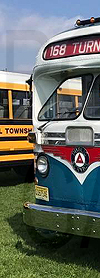
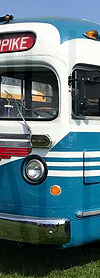
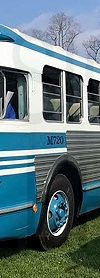
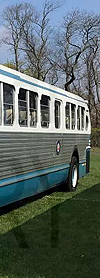
| New Jersey Public Service 1958 built GMC TDM-5108 #M720 is seen in Wall, NJ on April 28, 2018 at a Make A Wish Foundation event called "Touch A Truck". The bus is displaying a rollsign similar to the one here. (Photo courtesy of the “Friends of the New Jersey Transportation Heritage Center" transit museum. Used with permission.) |
This mylar rollsign section contains routes from NJPS's Oradell
depot, and was believed to be from a GMC New Look bus. It is
about half of a full rollsign, with several routes missing from the
beginning. The rollsign has no print date. It has 33 exposures.
The Route 168 exposure at the end was a later addition.
depot, and was believed to be from a GMC New Look bus. It is
about half of a full rollsign, with several routes missing from the
beginning. The rollsign has no print date. It has 33 exposures.
The Route 168 exposure at the end was a later addition.

| The history of what became New Jersey Public Service began in the 1890s with the introduction and expansion of electricity and the many independently operated streetcar services. The companies were independently run and some were losing money or unable to do costly maintenance or improvements. Using a consolidation model proven by United Gas Improvement of Pennsylvania, several power utility operators energy merged into a holding company called United Electric Company of New Jersey in 1899. It was broadened to include streetcar operations who had to generate their own electric power, allowing these companies to stabilize financially. The Public Service Corporation (PSC) was formed on May 6, 1903 with the merger of four streetcar companies that served Bergen, Essex, Hudson and Passaic counties, and a power company. Soon after it consolidated other utility and streetcar companies from all over New Jersey, growing to merge over 400 companies total. Most were acquired through long term leases or by acquiring large stakes in the companies to take over their boards of directors, rather than being purchased outright. All of PSC's acquisitions fell under five subsidiaries, Public Service Railway Company (for streetcars and the Newark subway), Public Service Electric Company, Public Service Gas Company, United Electric Company of New Jersey (in 1907) and Public Service Transport Company (for bus services) in 1917. The first four were holding companies. In 1928, the five entities were merged into just two, Public Service Electric & Gas Company, and Public Service Coordinated Transport, which consolidated the rail service from the Public Service Railway Company and bus service and bus service from the Public Service Transportation Company. All these acquisitions and consolidations helped lower rates and fares across the network and allowed for free transfers between transit services. PSC began experimenting with "All Service Vehicles" in 1935. These were trolleys that could run on the road as well as on rails, and could run on both electric and gas power. This contributed to the decline of streetcar use in favor of buses. The use of All Service Vehicles ended in 1948. Also in 1948, due to federal and state antitrust concerns, Public Service Corporation was dissolved. The Electric & Gas side went from being a subsidiary to an independent public company. In 1971, Public Service Coordinated Transport was renamed to Transport of New Jersey. With large rail service providers declining, the state began to asses the issue of gaps in the commuter network during the 1970s, and in 1979 the Department of Transportation formed New Jersey Transit. Other bus companies were later acquired which included Transport of New Jersey in 1980. This ended Public Service's role as a transportation provider, and it became exclusively an energy utility. |